
Discover why smart investors are switching to Gold ETFs. Learn how to avoid high making charges and locker fees while keeping your gold investment safe.
In recent months, the commodities market has been the talk of the town. If you open any newspaper, scroll through social media, or watch a business news channel, one headline dominates the conversation: Gold and Silver have delivered record-breaking returns.
This surge in value has reignited the age-old passion for investing in precious metals. However, for the average investor, this excitement often comes with a simple yet confusing question: “If I want to invest in gold or silver today, what is the best way to do it?”
With gold prices soaring—often requiring ₹12,000 to ₹15,000 just for a single gram—buying gold has become a significant financial decision. It is no longer something you can do casually. This high barrier to entry stops many potential investors in their tracks.
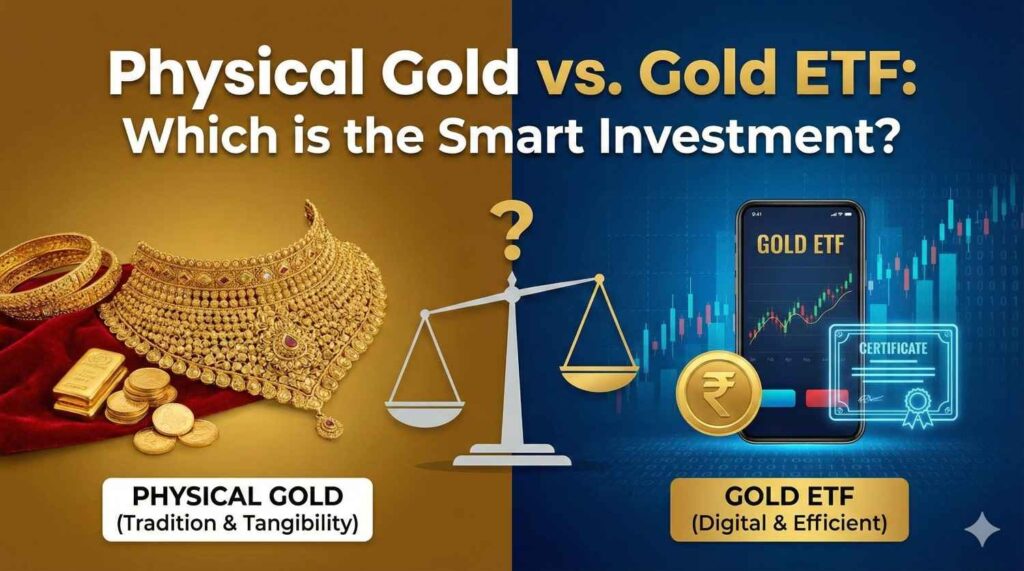
In today’s post, based on our latest video from the Easy Finance YouTube channel, we are going to break down the two primary ways you can invest in gold: the traditional Physical Gold route and the modern Gold ETF (Exchange Traded Fund) route. By the end of this guide, you will know exactly which option suits your financial goals.
The Traditional Approach: Buying Physical Gold
For generations, “investing in gold” in India has meant one thing: walking into a jewelry shop and buying metal. Whether it’s for weddings, festivals like Dhanteras, or simply as a store of wealth, Indians have a deep emotional connection to physical gold.
Typically, physical gold is purchased in three forms:
- Jewelry: The most popular form, often bought for usage and status.
- Gold Coins: Bought in denominations like 1g, 5g, or 10g.
- Gold Biscuits/Bars: Bought by those looking to invest larger sums.
Once purchased, this gold is usually stored in bank lockers or hidden away in safe corners of the house for years, sometimes decades. While there is nothing inherently “wrong” with this traditional method, there are significant practical issues that most investors conveniently ignore—until it’s time to sell.
The Hidden Downsides of Physical Gold
While holding gold in your hand feels secure, it comes with financial inefficiencies that eat into your returns.
1. The Burden of Making Charges
When you buy gold jewelry, you aren’t just paying for the gold; you are paying for the craftsmanship. These making charges can range anywhere from 10% to 20% of the gold’s value.
- The Problem: When you go to sell that jewelry later, you only get the value of the gold. The making charges you paid are a sunk cost—you never get that money back. In investment terms, you are starting with an immediate loss of 10-20%.
2. Storage and Safety Concerns
Physical gold requires physical security.
- Home Storage: Keeping gold at home comes with the constant stress of theft or burglary.
- Bank Lockers: To mitigate theft risk, many people use bank lockers. However, lockers aren’t free. You have to pay annual rent, which adds a recurring cost to your investment. If your gold doesn’t appreciate enough to cover this rent, your real returns diminish further.
3. Purity and Verification Issues
For a common investor, verifying the purity of gold is a difficult task. Is it truly 24 karat? Is it 22 karat? While hallmarking has helped, selling gold often involves a purity test at the buyer’s shop. If you try to sell your jewelry at a different shop than where you bought it, they may question its purity or offer you a lower rate.
4. The Buy-Sell Spread
Have you noticed that the buying price of gold is always higher than the selling price at a jewelry shop? This “spread” ensures the jeweler makes a profit, but it means you need gold prices to rise significantly just to break even.

The Modern Alternative: Gold and Silver ETFs
Now, let’s talk about the alternative that savvy investors are turning to: ETFs (Exchange Traded Funds).
What is a Gold ETF?
Simply put, a Gold ETF is an investment in gold in paper (or digital) form. Instead of holding a physical coin or chain, you hold a certificate in your Demat account that represents the value of gold.
These ETFs are traded on the stock exchange, just like shares of a company.
How Does It Work?
The mechanism is transparent. The price of a Gold ETF tracks the actual market price of high-purity physical gold.
- If the price of physical gold goes up, the price of your ETF unit goes up.
- If gold becomes cheaper, the ETF price drops accordingly.
It reflects the live market movements without you ever needing to handle the metal itself.
Why Smart Investors Are Choosing ETFs
If your goal is purely investment—meaning you want to make money from the rising price of gold—ETFs offer clear advantages over physical gold.
1. Zero Making Charges
This is the biggest financial win. Since you are not buying a designed necklace or a minted coin, there are no making charges. You pay the market rate for gold. This means 100% of your money is invested in the asset itself, not in labor costs.
2. No Storage Headaches
Gold ETFs sit digitally in your Demat account. You don’t need to buy a safe, you don’t need a bank locker, and you don’t need to lose sleep over thieves. It is as safe as your stock portfolio.
3. Absolute Transparency
The price of an ETF is linked to the market. It is transparent and uniform. You don’t have to haggle with a jeweler or worry that you are being quoted a “different rate” because you are selling an old design. You can buy and sell instantly during market hours at the live price.
4. High Liquidity
Selling physical gold can be a chore. You have to physically go to a shop, get it melted/tested, and negotiate. With ETFs, you can sell your holding with a single click on your mobile phone, and the money comes into your bank account.
5. Start Small
As mentioned earlier, buying even 1 gram of physical gold today requires a lump sum of ₹12,000+. In contrast, you can start investing in Gold ETFs with as little as ₹100 or ₹200. This democratizes gold investment, allowing students, salaried professionals, and small savers to participate in the gold rally without breaking the bank.
A Strategic Approach: The “Wedding Plan”
A common counter-argument to ETFs is: “But I can’t wear an ETF paper to a wedding!”
That is true. In India, we often buy gold because we know we will need jewelry for our children’s marriages 5, 10, or 15 years down the line.
Here is a smarter strategy suggested in our video:
If you know you need gold for a wedding 10 years from now, do not buy the jewelry today.
- Fashion Changes: Designs you buy today might look outdated in 10 years.
- Safety: You will spend 10 years paying locker rent or worrying about theft.
Instead, follow this path:
- Accumulate via ETFs: Buy Gold ETFs regularly over the next 10 years. You can buy small amounts every month (like an SIP).
- Hold Long Term: Let the value of your ETFs grow exactly as gold prices grow.
- Switch at Maturity: When the wedding is close, sell your ETFs. Withdraw the cash (which has now appreciated with gold prices) and walk into a jewelry shop to buy the latest designs.
The logic remains the same—you are hedging against gold price inflation—but you avoid the hassle of storage and the loss of making charges on “outdated” designs.
Are There Any Risks?
It is important to be realistic. While ETFs solve the storage and cost problems of physical gold, they are still a market-linked product.
- No Guaranteed Returns: ETFs do not promise a fixed interest rate. If gold prices crash globally, the value of your ETF will also go down.
- Volatility: Just like physical gold, ETF prices fluctuate up and down based on global economic factors.
However, historically, gold has been a hedge against inflation, and over the long term, the price trends of ETFs and physical gold will look almost identical.

How to Get Started with Gold ETFs
If you are convinced that ETFs are the right way to go, the next question is: “How do I buy them?”
Since ETFs are traded on stock exchanges (NSE/BSE), you need a Demat account.
- If you already invest in stocks, you can search for Gold or Silver ETFs in your existing app and buy them instantly.
- If you are a beginner, you will need to open a Demat account first.
In our video, we recommended Angel One as a reliable option for beginners and experienced traders alike to explore ETF options. They offer a smooth interface where you can easily search for, buy, and sell Gold and Silver ETFs.
(Note: You can find the link to open an Angel One account in the description of our YouTube video.)
Conclusion: Which One is Better?
The answer depends on your purpose.
- Choose Physical Gold If: You need it now for immediate consumption (wearing it for an upcoming event) and you value the emotional satisfaction of holding the metal.
- Choose Gold ETFs If: You are an investor looking to grow your wealth, you want to avoid unnecessary fees (making charges/locker rent), and you want the flexibility to start with small amounts.
At Easy Finance, we believe that for pure investment purposes, the ETF route is mathematically superior due to the cost savings and liquidity. It strips away the inefficiencies of the old system while keeping the core benefit: exposure to the evergreen value of gold.
What do you think? Are you a fan of the traditional yellow metal in your locker, or are you ready to switch to digital gold? Let us know in the comments of our video!
Disclaimer: This blog post and the associated video are for educational purposes only. We do not provide investment recommendations. Please do your own research or consult a certified financial advisor before making any investment decisions.
If you found this guide helpful, don’t forget to visit our YouTube channel Easy Finance, where the Easy Finance simplifies money matters for you every week!
Useful Links – Top 5 SIP Mistakes







Leave a Reply